
This could become tricky territory for India, given its basically adversarial relationship with China, its moves to block imports and investment from that country, and to deny market access for Chinese technologies, observes T N Ninan.

The leaders of the five emerging market economies are expected to sign a deal on Tuesday that creates the $100 billion bank and a reserves fund of the same size to challenge Western dominance over global finance.

The decision was taken at the BRICS Summit in Durban which also launched a Business Council to encourage investment and trade in member countries and to expand business cooperation.

The BRICS nations on Friday underlined the need for using local currencies in international trade and financial transactions besides committing themselves to supporting rule-based open and transparent global trade. A joint statement issued at the end of the meeting of the BRICS Ministers of Foreign Affairs and International Relations, also pressed for a robust Global Financial Safety Net with a quota-based and adequately resourced International Monetary Fund (IMF) at its centre. It further said the process of IMF governance reform under the 16th General Review of Quotas, including a new quota formula as a guide, should be completed by December 15, 2023.

The grouping of Brazil, Russia, India, China and South Africa had in March decided to establish a new development bank -- BRICS Bank -- to finance infrastructure projects and to create a $100 billion contingency fund to tackle any financial crisis in emerging economies.
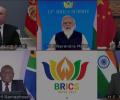
Asserting that it is for the first time that BRICS has taken a collective position on strengthening and reforming multilateral systems, Prime Minister Narendra Modi said, "We have to ensure that BRICS is more productive in the next 15 years".

The board meeting is likely to take place later in Shanghai.

Showing respect to the Indian flag, Prime Minister Narendra Modi on Wednesday immediately picked up the tricolour placed on stage at a BRICS meeting here to mark the standing place of every leader so as not to step on it.

The meeting will be attended by Russian President Vladimir Putin, Chinese President Xi Jinping, South African President Cyril Ramaphosa and Brazil's Jair Bolsonaro, according to the MEA.
P K Mishra, a retired IAS officer of the Gujarat cadre, is currently serving as the principal secretary to the prime minister.

Argentina, Egypt, Ethiopia, Iran, Saudi Arabia and the United Arab Emirates have been invited to join the grouping.

The members resolved to foster a global economic governance architecture that is more effective and reflective of current global economic landscape
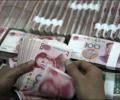
The NDB will have an initial authorised capital of $100 billion.

Modi said that there was an immediate need to strengthen the WTO, fighting protectionism, ensuring energy security and work together to fight terrorism.
India would neither succumb to the Americans on issues of national security, such as its defence ties with Russia, nor cede ground on its domestic interests in the agriculture and dairy sectors.

The BRICS summit offers Modi an excellent platform to reach out to world leaders and conduct diplomacy on the very ticklish issue of reform of the world governance structure, and to exchange notes with his peers on international, regional and bilateral issues on the margins of the meeting, says Rup Narayan Das.

Borrowing from BRICS bank will help India avoid other kinds of politics emanating from the West. Overall, the BRICS institutions will necessarily adopt alternative ways of doing things based on their own cultural and socio economic needs, says M K Venu.

'I don't think we have ever seen such alignment of everything that we need in the banking sector.'

Trump's new rules for how countries should treat him have led to the current breakdown in India-US relations, explains Ambassador T P Sreenivasan.

Modi knew in his heart that India does not have the financial muscle to support the new bank with offers of co-financing international projects, something China can do from the bank's base in Shanghai. If established in Mumbai, it may have employed a few Indian bankers and satisfied the national ego but there was little financial value to be drawn from it.

The announcement of the formation of the BRICS bank will have as much an impact about how the non-G7 countries manage their economies and their foreign reserves, as it does on the intellectual discourse. The development priorities and agenda which was hitherto set by western experts responding mostly to western priorities and notions will now have to compete with an intellectual tradition that is and can be very different, says Mohan Guruswamy.

Modi is also scheduled to hold a bilateral meeting with Xi on Tuesday.

The BRICS model will need to demonstrate the efficacy of a second alternative governance structure to reform the Bretton Woods legacy.

'Many countries believe that if they join BRICS, they will be seen as emerging countries and their stature will be enhanced.' 'G-20 still has common action plans while BRICS does not do that much.'

After visiting two Central Asian countries, Prime Minister Narendra Modi arrived in Ufa on Wednesday on a three-day trip during which he will attend the BRICS and Shanghai Cooperation Organisation summits.

BRICS has no plans to form a military and political alliance, Russian President Vladimir Putin said on Wednesday, in an apparent effort to allay apprehensions of the West.

The highlight of the first BRICS Summit on the African soil is the possible setting up of a development bank for undertaking infrastructure and development projects.

'It is unrealistic to expect that security dilemmas and strategic distrust to disappear or even diminish any time soon,' says Rup Narayan Das.

He also offered India's experiences of participative political institutions, local governance, media and civil society with Africa.
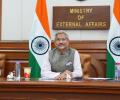
The BRICS stressed on resolution of conflicts in a declaration issued after a virtual meeting of foreign ministers of the member nations of the grouping. The meeting was attended by External Affairs Minister S Jaishankar and his Chinese counterpart Wang Yi.

The PM said there was a need to tackle the problem of terrorism in an organised manner.

'There's no pro-China tilt in BRICS.' 'All these countries want to be close to China, but they are all good friends of India also.'
Srikanth Kondapalli on what to expect from the seventh BRICS summit meeting to be held in Russia in July.

With its political colour dominated by less than democratic trends, BRICS currently leaves some of us wondering -- where in this grouping is there an assurance that human freedom will be respected unconditionally? It would be nice to see the new members of BRICS drawn from the ranks of countries wedded to preserving and guarding human freedom, observes Shyam G Menon.

Prime Minister Narendra Modi said he looks forward to useful conversations with his fellow leaders from China, South Africa, Brazil and Russia on addressing pressing international and regional challenges that stand in the way of their goals.

The agenda is to give a concrete shape to a Development Bank and pitch for reforms of the UN Security Council.

Prime Minister Manmohan Singh on Thursday left Durban for home, ending a four-day visit during which he attended BRICS (Brazil, Russia, India, China and South Africa) Summit that decided to establish a development bank to finance infrastructure projects in emerging economies.

'Happily,' says Ambassador B S Prakash, 'BRICS displayed new-found energy and built something real, a bank. Between needless nihilism and as yet unjustified euphoria, there are many stations for the BRICS train and we can watch its progress with renewed interest.'

Emerging nations have discussed delinking the quotas from the governance reforms to facilitate its passage.
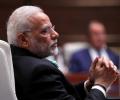
Modi said a separate rating agency would help the economies of the member countries as well as other developing nations.
